

.svg)

Back to all articles
Bridging the Gaps — between Systems and Humans (Part 2 of 3)
Every caregiver becomes the bridge between people who don’t talk to each other — hospitals, specialists, relatives — all connected through you.

When Mum decided to go ahead with the shoulder replacement, planning began almost immediately. I reached for what I knew best — lists, timelines, notes 📋.
It wasn’t that I didn’t trust the system — it’s that the system rarely spoke to itself. Someone had to hold the whole story together, and that someone, inevitably, was me.
🕰️ After every consultation I kept meticulous notes: what the surgeon said, what came next, what medications needed adjusting. Late at night, I’d turn those notes into tidy memos, export them to PDF, and send them to family such as my sister and uncle.
It gave everyone the same information — and gave me the sense that I knew what I was doing. Looking back, those documents helped me bring my best out for Mum and manage the anxiety. Her anxiety and mine.
Then came the scans. Different providers, different systems, same confusion. I recall at midnight crouched for my laptop, saving MRI files off a CD-ROM (yes, really — because that’s how they provide them to you), clicking through grainy images of Mum’s shoulder — bone now more cliff than curve — screenshotting them frame by frame so I could share them digitally.
💻 It was a strange combination of devotion, shock, and frustration, watching the structure of her pain appear image by image. It doesn’t take someone with a biomedical background to recognize the swelling, bone deterioration, and strained tendons that obliged her with constant soreness.
Somewhere between the emails and screenshots I realized I’d become the bridge, or like a human API — not just the interface between clinical systems, but between people. I was translating medical language for family, emotional context for doctors, and hope for everyone else.
That’s what most caregiving really is — the work that happens between things. Between one doctor and the next, one message and another. You become the connective and nervous tissue of a body where clinicians and family members represent limbs, fingers, eyes. You’re constantly making sure the signals don’t get lost.
When I think back on that period, I don’t remember the appointments or the paperwork as much as the bright screen of my laptop as I repeatedly hit ‘Prt Sc’ to get those screenshots — all with quiet determination to get it right.
💭 Caregiving taught me that information itself can be an act of care.
Keeping the threads from unraveling is its own expression of love — a way of saying, “I’m holding this together until you can.”
Join me on my Substack: Caregiving, Practically Speaking, for more stories, tools, and truths from the frontlines of caregiving.
.jpeg)
The Exhaustion that Sleep Doesn't Fix
Why caregiving fatigue isn’t about rest — and what’s actually draining you

Shoulder, Strength, and the Quiet Courage to Face the Pain (Part 1 of 3)
There’s nothing dramatic about the way functional ability slips away. It’s gradual — barely noticeable at first — until one day you realize that pain and constraints have replaced motion.
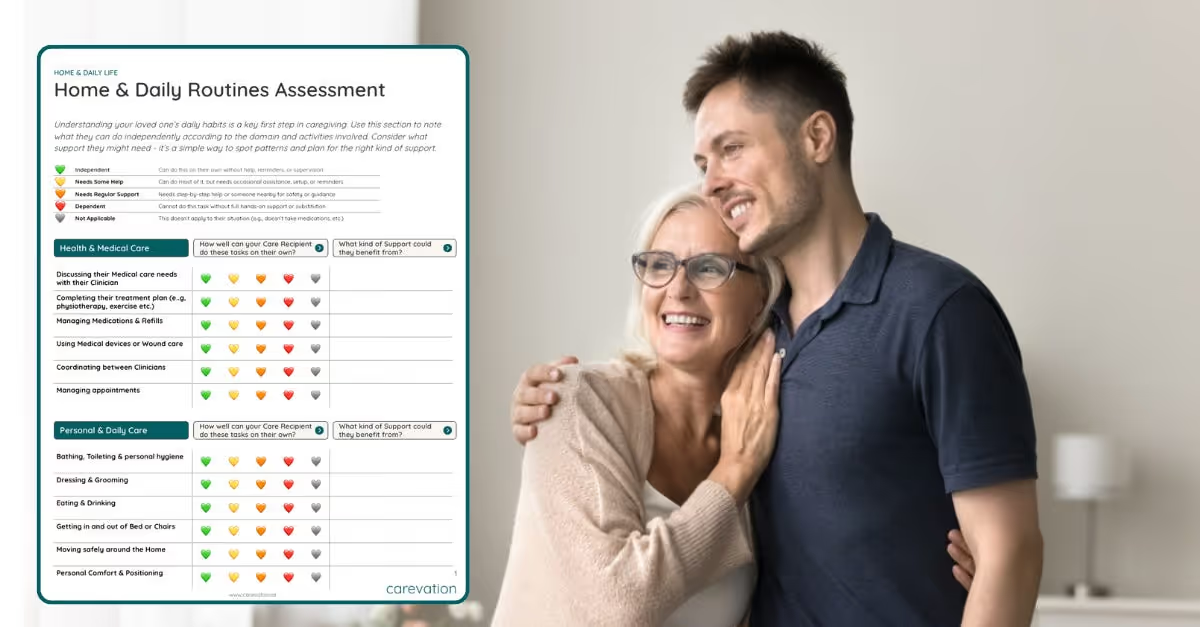
How to Understand Where Your Loved One Truly Needs Support
A practical way to assess daily life before crisis forces the conversation.
%201%20(1).svg)


.png)
.png)