


Back to all blogs
How to Understand Where Your Loved One Truly Needs Support
A practical way to assess daily life before crisis forces the conversation.
Caregiving rarely begins with a formal conversation.
More often, it begins with small observations.
A wince while lifting something heavy.
A slower pace crossing the street.
A quiet comment: “I don’t go to the driving range as much — I can’t keep up with the walking.”
On their own, these changes aren’t alarming. But when they begin to accumulate across multiple parts of daily life, they start to form a pattern.
That’s how caregiving creeps up on us — in the details.
For Mum, one of those details was cooking.
She had always been a passionate chef — moving woks with confidence, layering dishes in precise timing, feeding our family with both Chinese and Western meals. But over time, years of inflammation in her joints caught up with her. Moving heavy saucepans filled with piping hot food became difficult. Lifting trays into the oven required more effort. Keeping pace with her own standards became exhausting.
It was hard to watch — because cooking wasn’t just a task. It was dedication, identity, love.
And yet, neither of us fully named what was happening.
I told myself she had managed so far. If she needed help, she would ask.
But she rarely did. She didn’t want to feel like a burden. And I avoided pressing the issue because it felt intrusive — almost like I was trying to take something from her.
There is a delicate balance between preserving independence and offering support. Between waiting to be asked and stepping in proactively.
I still wrestle with that balance.
What I lacked back then wasn’t care or willingness.
It was a structured approach.
🌿 Seeing Daily Life as a Whole
Over time, I realized I needed a clearer way to step back and look at daily life more holistically — not just react to isolated moments.
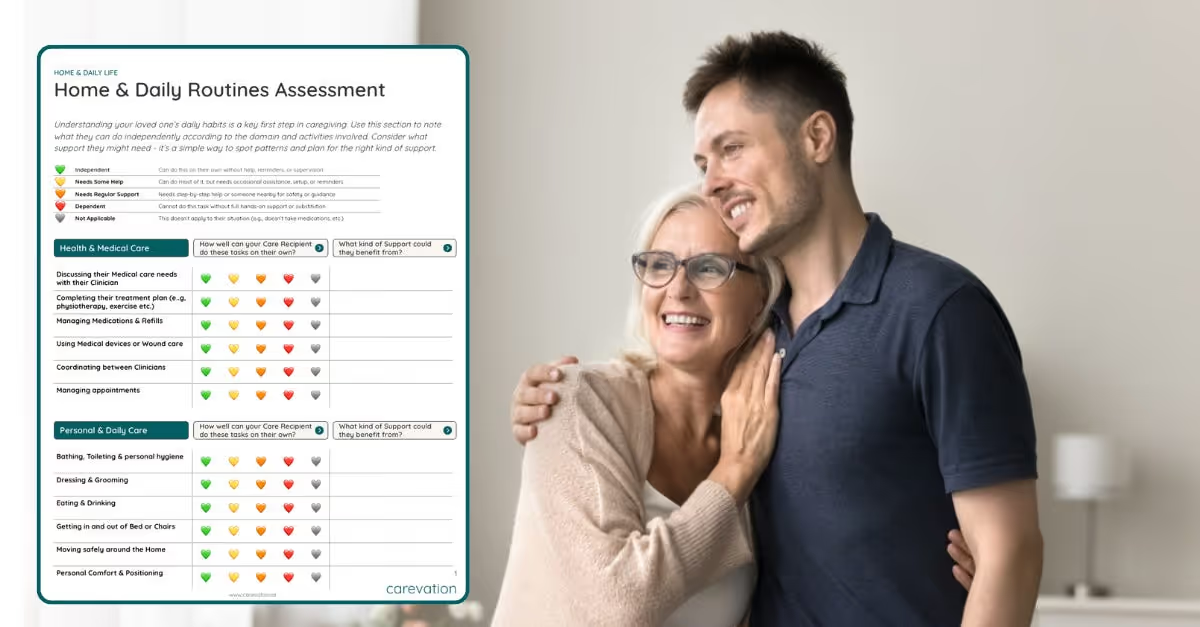
That’s why I created the Home & Daily Routines Assessment — a simple framework to help caregivers evaluate how their loved one is managing across different areas of life.
It’s divided into six domains. Not because caregiving needs to feel clinical, but because structure brings clarity.
1. Health & Medical
Appointments, medication routines, symptom changes, using devices, coordinating between providers. Care doesn’t end at the clinic — it gets implemented at home.
2. Personal & Daily Care
Bathing, dressing, toileting, eating, safe transfers, positioning. These activities can quietly become more physically demanding long before anyone says so.
3. Household & Environment
Cooking, cleaning, laundry, grocery shopping, transportation, navigating stairs, moving safely around the home. Small inefficiencies often signal bigger strain.
4. Paperwork & Finances
Managing bills, insurance claims, organizing documents, budgeting. The administrative load of care can rival the physical one.
5. Family & Social
Maintaining friendships, attending gatherings, staying engaged in meaningful activities. Isolation doesn’t always look dramatic — sometimes it’s simply fewer invitations accepted.
6. Cognitive & Emotional
Memory, decision-making, mood, frustration, loneliness. Emotional shifts matter just as much as physical ones.
Within each domain, you can simply ask:
- Can they do this independently?
- Do they need occasional support?
- What level of consistency do they need?
- Who is best positioned to help?
It’s not about labeling decline. It’s about noticing patterns. It’s about agreeing on adjustments — and how to incorporate them into daily life.
🤝 Creating a Circle of Care
Care is rarely meant to be carried alone.
One part of the framework encourages mapping out a “circle of care” — identifying who can realistically help, and how.
Maybe one family member manages finances.
Maybe someone else handles grocery runs.
Maybe another checks in weekly.
Writing it down clarifies expectations and reduces the quiet assumption that one person will hold everything together.
Because without structure, caregiving defaults to whoever is most attentive — not necessarily whoever is most sustainable.
🪴 A Starting Point, Not a Takeover
The goal of this assessment isn’t to take control away from your loved one.
It’s to help you see clearly.
You don’t need to complete it all at once. You don’t need to have every answer. But having a framework allows you to move from vague worry — “I think something’s changing” — to thoughtful conversation.
Care begins in the details. Structure helps you respond with intention.
📘 Download the Home & Daily Routines Assessment for free on the Carevation Resources page here: https://www.carevation.ai/resources
Start where you are.
Add to it as things evolve.
And let clarity replace uncertainty — one aspect at a time.
Join me at care4caregivers.substack.com for more stories, tools, and truths from the frontlines of caregiving.




Thanks for joining the Carevation list.

Carevation is a digital platform that helps caregivers manage appointments, medications, and the daily work of care — all in one place.

