


Back to all blogs
From Chaos to Calendar: Learning to Manage My Mum’s Care
A personal account of how caregiving responsibilities crept in — and how I slowly built a system to handle the complexity.
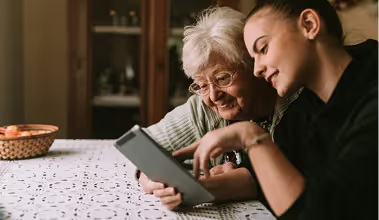
Becoming my Mum’s primary caregiver came with a whole new set of responsibilities—and an increasing workload. Doing it across time zones only made it harder.
There came a point when I had to devise some kind of system just to stay afloat. But even calling it “staying organized” feels inadequate. It’s one thing to track things efficiently, and another to understand a tsunami of information, weigh its implications, make decisions, and coordinate with others. This is why caregiving feels like a full-time job—or two.
Facing Complexity
Aging parents will likely develop multiple chronic conditions and Mum was no different. But to my surprise, I found the complexity of care increased exponentially with each new layer. Adding another set of specialists, appointments, or medications led to what felt like an order of magnitude increase in work. Her care became a project in itself.
There were so many interconnected layers to keep in view. For example:
- How would changing a medication impact her other conditions? What did we need to watch out for and for how long?
- If she needed a procedure, what input did I need from her other specialists so we aren’t missing possible sources of complications?
- Could her test results be shared across all her doctors—even though they were in different health systems?
- She’s developing a skin rash—is it due to changing seasons, a reaction to medication, or something she ate?
Notes, Notes, Notes
There were countless test reports, discharge handouts, and appointments to track. And so many notes. Taking good notes became essential—not just because I have the memory of a goldfish, but for allowing oneself to reflect before summarizing and conveying important details to other family members. That too became a powerful skill set.
In one consultation, we gave each other the awkward look of “we should probably take notes..” as it became clear we were not keeping up with the firehose of information coming at us.
I reached for my phone and started typing into an email app—familiar, quick, and searchable. It worked in the moment, but it wasn’t sustainable. Draft emails weren’t going to cut it in the long term.
The Tools We Reached For
Mum had her own approach: scribbling on the backs of envelopes, or bits of paper. At one point she was tracking glucose readings in a notebook—until that, too, fell away.
We tried using group texts and chats to share updates, but those got buried under holiday plans, family gossip, and an endless stream of cat pics. And you can never have too many cat pics. 😻
Things came to a head when Mum needed surgery. The information overload—risks, aftercare, outcomes—was intense. I found myself researching every aspect of the procedure, trying to explain options to other family members, and mapping out our post-op plan.
Doctor Google is powerful—but tread carefully. Avoid at all costs falling down a Reddit rabbit hole of anecdotal stories that for me, could lead to a self-induced panic. Sorting through all that information was exhausting. Analysis paralysis is real.
Building the Bare-Bones System
Eventually, I started to see the outline of a system emerge. I:
- Used my notes app to track symptoms and visits
- Created a calendar for appointments and reminders
- Collected attachments and contact details in one place
- Used spreadsheets to log medical history
It worked for a while. But switching between platforms was clunky. And getting other family members to participate was difficult—what was intuitive for me wasn’t intuitive for them.
Even then, being organized didn’t mean I could see the big picture. I could track individual elements, but not how they connected. That required interpretation. And despite my biomedical background—“just enough to be dangerous,” as they say—I still doubted myself. The array of questions keeping me up at night never stopped:
- What should I bring up with Dr. Johnson at our next visit?
- Where can I find a home care aide for a few hours a week?
- What are the live-in care options—and how long will they last?
- What home modifications do we need to make Mum’s environment safer?
These weren’t one-off decisions—they were ongoing calculations, updates, and adaptations.
A Few Years later, and We’ve Found a Rhythm
Fast-forward a decade, and I’ve gotten better at managing it all. We’ve had a few trials-by-fire, but now there’s a rhythm. We know our roles. We know the questions to ask and the paperwork to expect.
Right now, we’re in a relatively stable period. Predictability and calm are a gift—but if and when things change again, I feel more ready to meet them.
💬 I’d love to hear from you
If you’ve taken on caregiving responsibilities—how did you adapt?
What tools helped you?
Where did you feel most unsupported?
Whether you’re early in the journey or decades into it, I’d love to hear what’s helped you stay grounded.
Join me at care4caregivers.substack.com for more stories, tools, and truths from the frontlines of caregiving.




Thanks for joining the Carevation list.

Carevation is a digital platform that helps caregivers manage appointments, medications, and the daily work of care — all in one place.

