


Back to all blogs
Caregiving, Practically Speaking The Human API Problem in Healthcare
Why care still depends on people to connect what systems cannot

🔌 What an API Does — and Why It Matters
There’s a technical reality inside modern healthcare:
Most systems don’t talk to each other — at least not seamlessly.
Hospitals have electronic health records (EHRs). Specialists have their own portals. Labs report results in separate systems. Pharmacies operate in parallel. Each plays a role, but the system is fragmented and uneven.
In theory, interoperability exists but there are gaps that are often bridged by… a person.
And more often than not, that person is a family caregiver.
To understand why, it helps to step briefly into the world of technology.
An API — an Application Programming Interface — is what allows systems to communicate with one another. It standardizes how data is exchanged, ensures information flows accurately, and reduces duplication and error. Without APIs, software becomes siloed. Data gets trapped. Processes slow down as systems fail to connect.
Healthcare is fundamentally an information-driven domain. From symptoms to diagnosis to treatment to monitoring and adjustment, every step relies on information flowing clearly across people and systems.
But in reality, that information lives in multiple places. Some of it is structured — lab values, imaging results, prescriptions. And even within that data, there is a stream of trade-offs, concerns, decisions, mitigations that only exist in conversations, observations, and lived experience not captured within clinical systems.
And that is where something striking begins to emerge — I see that family caregivers function as human APIs.
They relay medication changes across specialists. They provide context and articulate nuanced reactions of their loved ones. They remember how each decision was made. They translate discharge instructions into daily routines. And so much more.
Caregivers besides being information conduits, are continually interpreting, prioritizing, and consolidating health insight, then turning it into real-world care.
🧠 The Human Layer: Memory, Context, and Feedback Loops
This is why caregiving isn’t just physical — it is deeply cognitive and organizational.
In my earlier writing, I reflected on how caregiving lives in your head — an evolving history of observations, decisions, experience, and even mistakes. That memory becomes the foundation for everything that follows.
You remember which medication reduced the swelling. When dizziness first appeared. Whether appetite declined before or after a dosage change. How they responded the last time a painkiller was prescribed. How sleep shifted after surgery.
None of this is neatly structured. It sits across conversations, notes, messages, and the back of your mind. And yet it is critical because of its role in the feedback loop of care — assessing whether treatment works and refining in conjunction with health professionals.
So when you sit in a clinic room and the doctor asks, “So what’s been going on?” — you become a critical data layer.
You compress weeks of lived experience into a short summary.
If something is forgotten, the system doesn’t know. If something is misremembered, the error propagates. Which may mean your loved one not getting the care they need.
That’s not a failure of the individual. It’s a reflection of a system that relies on an exhausted, over-worked human who is trying to keep everything together.
Healthcare information is siloed — not just across institutions, but across forms of knowledge. Clinical data sits in charts. Lived experience sits with the patient and caregiver.
Decisions are made at the intersection of both — often within brief, time-constrained consultations. When clinical expertise is paired with lived context, care becomes more effective because it aligns with the reality at home.
🏥 Where EHRs and Portals Help — and the Last Mile
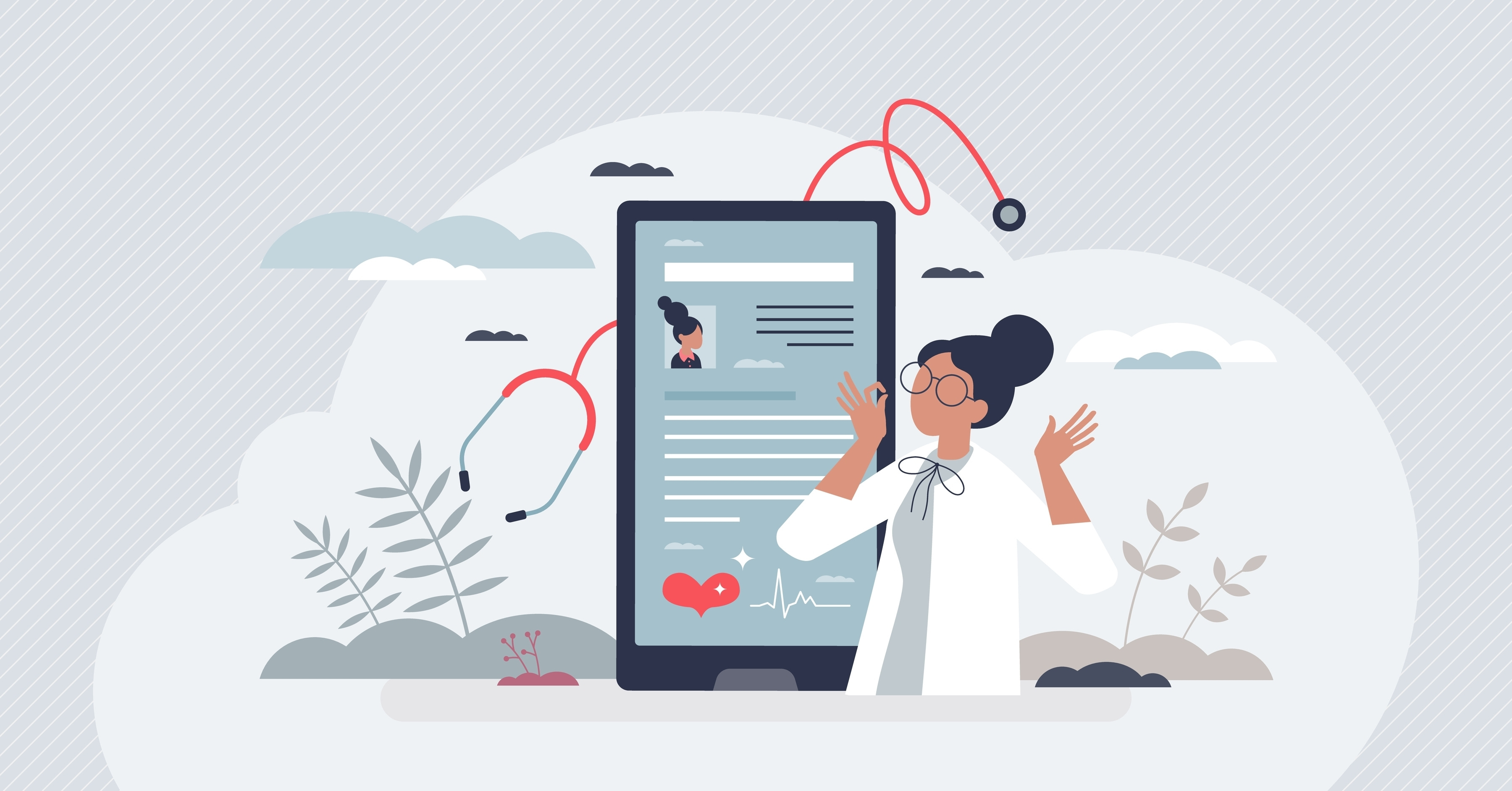
Electronic Health Records (EHRs) and pateint portals have improved access signfiicantly. And yet they are the perfect demonstration of the gap between clinical care and the experience outside the health system.
EHRs allow results to be viewed, messages to be sent, and documentation to be shared. They improve visibility within individual systems (usually).
But access is not the same as integration.
They are designed primarily as systems of record and to support clinical workflows — a way to document and exchange information within clinical environments. They are not designed around the needs of caregivers, nor do they integrate the lived context of care at home.
And so the last mile remains. Covered by a person.
What exists in the chart is written in clinical language. It reflects diagnosis, treatment plans, and observations within a medical framework. But everyday care does not happen in that language.
It happens in routines. In meals. In reminders. In behaviors. In decisions made throughout the day. It is here where a caregiver, on instruction from the physician, takes a care plan and turns it into action in the real world.
⚠️ When the System Depends on a Person
In engineering, manual data transfer is considered inherently fragile.
It introduces latency, inconsistency, and the risk of error. Context can be lost as information moves between systems. Small gaps can compound over time.
The same is true here. And it becomes even more so when multiple caregivers are involved.
If a subtle behavioral change is not mentioned, intervention may be delayed. If a dosage adjustment is misunderstood, adherence may falter. If someone is overwhelmed, coordination begins to break down.
At the same time, not everything can be reduced to structured data.
Healthcare requires interpretation and judgement.
“Monitor for swelling” sounds straightforward — until it isn’t. What level of swelling is expected? At what point does it become concerning? Should it trigger a call, or continued observation?
Clinical data provides an understanding of physiological drivers, which inform treatment decisions. But how it is translated into care at home and quality of life is a whole different layer.
This is where caregivers provide the crucial link.
How is the patient tolerating the medication?
Have there been subtle changes in behavior or mood?
Is adherence realistic within the current routine?
Are there barriers at home that affect care delivery?
This is also where shared decision-making becomes meaningful — where clinical recommendations are shaped by the patient’s lived reality.
In software, relying on this kind of manual, interpretive layer without support would be considered a fragile architecture.
But in healthcare, it is often simply how things work.
🌱 What Would a Better Architecture Look Like?
Caregivers aren’t just supporting appointments or providing companionship.
They are maintaining continuity across fragmented systems — integrating clinical, behavioral, environmental, and social information in real time.
So the question becomes, how can we integrate these worlds more seamlessly?
We can start by asking better questions.
- How do we recognize caregivers as part of the care team — not just in principle, but in how information flows and decisions are made?
- How do we reduce the cognitive load of holding the full picture — so that understanding and coordination don’t depend on memory alone?
- How do we support the translation of clinical guidance into real life — not just through instructions, but through ongoing context?
- How do we make it clearer what matters, and why — so attention is directed where it has the most impact?
- How do we design for continuity — so that information, decisions, and context don’t reset at every encounter?
- How do we combine clinical data with lived experience in a way that is usable?
- How does the system account for inevitable gaps — missed information, misinterpretation, or overload?
The goal is to recognize their role as connective tissue, and provide a means to incorporate their perspectives into decisions that impact health and the home.
🖼️ Seeing the Big Picture
For a long time, I thought I was simply being attentive.
Tracking symptoms. Updating doctors. Reconciling medications.
Only later did I realize I was acting as the missing link in a system that wasn’t fully connected.
Family caregivers are often described as advocates but perhaps a more accurate description is they are the integrators.
The human API. They make the big picture possible.
And so long as healthcare lives across clinical, digital, and home environments, their role will remain essential.
Join me at care4caregivers.substack.com for more stories, tools, and truths from the frontlines of caregiving.




Thanks for joining the Carevation list.

Carevation is a digital platform that helps caregivers manage appointments, medications, and the daily work of care — all in one place.

