


Back to all blogs
别告诉她 — What Awkwafina's "The Farewell" Taught Me about the Cost of Being Protected
A film, a mother's fall, and the cost of being kept in the dark
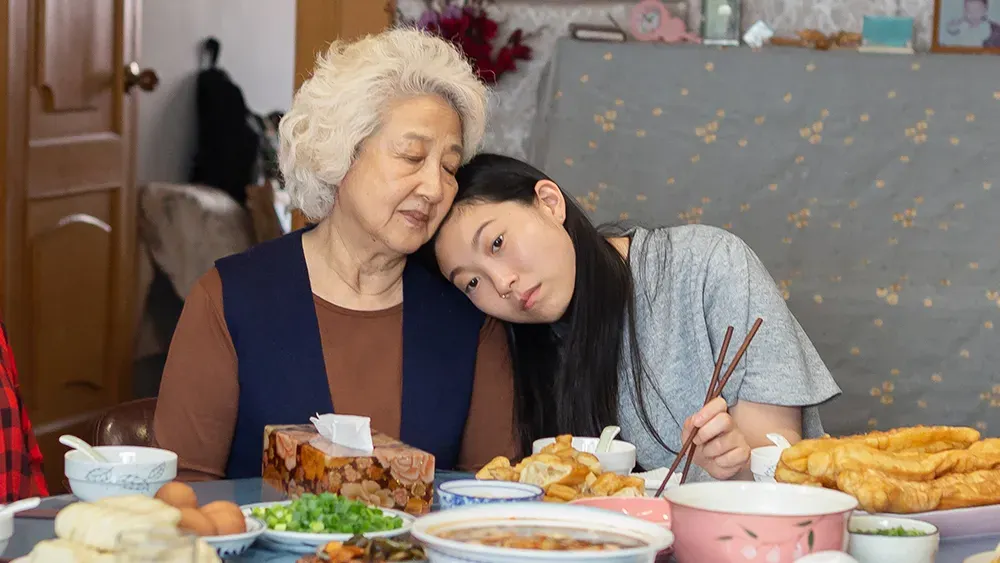
Not knowing the truth
There’s a particular kind of anger that comes with being protected from a truth you deserved to know.
Last month, Mum had a fall. She passed out, spent time in hospital, and was eventually discharged and back home. I found out days later, when she recounted it almost in passing. And I was absolutely livid.
Not at her, exactly. But at the situation. At the image I couldn’t stop constructing — her in a ward, alone, surrounded by doctors, unable to fully understand what was going on around her. I’ve been in that room with her before. I know what she needs in those moments. I know how to navigate those conversations, what to ask, what to push back on. But being there hadn’t been presented as an option. Instead I spent hours afterwards piecing together what had actually happened and what the doctors had said.
She hadn’t told me because she didn’t want me to worry. In her mind, she was carrying the burden so I didn’t have to.
I understood why. Yet I couldn’t accept it. Speaking only for myself, I’d much rather know the truth so I can decide how to respond — giving me my dignity is the greatest kindness you could provide.
It’s that specific tension — between the instinct to protect and the cost of being protected — that came back to me watching The Farewell, Lulu Wang’s 2019 film that I’ve been sitting with since.
Awkwafina — known for Crazy Rich Asians, Shang-Chi and the Legend of the Ten Rings, and her own Nora from Queens — plays Billi, a young Chinese-American living in New York with a close relationship with her grandmother Nai Nai who lives in China. When Nai Nai is diagnosed with terminal cancer, the family makes a collective decision: don’t tell her. Instead, they stage a surprise wedding as a reason for the whole family to gather one final time before her expected passing.
The film opens with a title card: “Based On An Actual Lie.” Because it is. This is director Lulu Wang’s own story — her family kept the diagnosis from her grandmother, and The Farewell is her attempt to make sense of it. On the surface it’s a comedy — warm, wry, and quietly devastating. But underneath, it’s asking something most caregiving conversations don’t want to go near:
Who gets to decide how much someone knows about their own ending?
That question landed differently after Mum’s fall. Because I found myself on both sides of it — furious at having been kept in the dark, and also recognizing, uncomfortably, why it happens. The overwhelming instinct to protect the people we love from difficult truths we can’t do anything about is not cruelty. It is, in its own way, an act of love.
The film just makes you feel the cost of it.
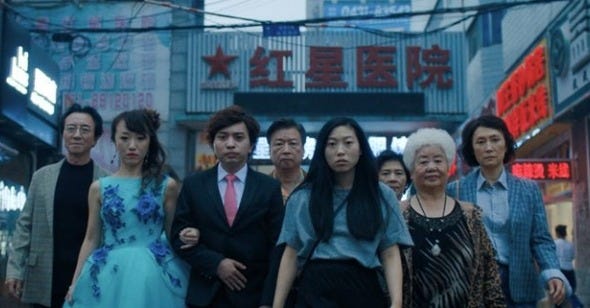
Who gets to decide
The Chinese title of the film — 别告诉她 (Bié Gàosù Tā) — translates simply as “Don’t Tell Her.” It’s a more honest title than The Farewell, because the film isn’t really about saying goodbye. It’s about who holds the truth, and who gets to decide that someone else shouldn’t.
The family’s reasoning is that Nai Nai would rather celebrate a wedding than grieve a diagnosis. That ignorance, in this case, is a kindness. And there’s a logic to it that’s hard to fully dismiss. She is happy. The family is together. Why introduce a weight she can’t lift?
But Billi can’t let it go. And I think I understand why.
When you’re kept from a truth that directly concerns someone you love, you lose something beyond the information itself. You lose the chance to respond. To decide how to show up. To say what needs to be said while there is still time to say it. You lose your agency in something that is yours to be part of.
What Mum thought she was giving me by not calling was relief. What she actually took away was the choice. And in caregiving — where so much already feels out of your control — having your choices made for you, even lovingly, lands harder than it might seem from the outside.
The film doesn’t resolve this cleanly, and it can’t. There are real arguments on both sides. But it does ask a question worth sitting with: if we accept that a loved one might one day need others to make decisions for them, have we ever actually talked about how they’d want that to go? Not just the formal instruments — the will, the power of attorney, the medical directive — but the conversation underneath them.
Do you want to know? How much do you want to know? What would you want us to carry, and what would you want to carry yourself?
These conversations are uncomfortable to start. But starting them — even without a clear answer — plants something. It gives the person space to begin forming their own response, in their own time, before a moment forces the question.
East, West, and the weight in between
One of the aspects the film captures well is that this isn’t just a family disagreement. It’s a cultural one.
The decision not to tell Nai Nai forms quickly, and it forms collectively. Her younger sister — the next most senior in the family — backs it. The others fall into line. There’s a hierarchy at work, and a shared instinct that in this family, in this cultural context, the group absorbs the burden so the individual doesn’t have to.
I recognize that instinct. Growing up between cultures means you absorb both sets of logic without fully belonging to either. There’s a part of me that understands the Chinese collectivist impulse — the idea that protecting someone from pain is an act of love, not deception. And there’s my British-American part that has spent years in a context where individual agency and informed consent are treated as near-sacred.
Mum not telling me about the fall lived in that same space. It was protective, relational, and deeply cultural. It was also, from where I was standing, the wrong call.
What the film does honestly is show that neither position is simply right. Billi’s American instinct toward transparency isn’t portrayed as obviously superior. The family’s Chinese collectivism isn’t portrayed as obviously wrong. The discomfort is left where it belongs — in the middle, unresolved, because that’s where most of us actually live.
For those of us managing care across cultures and across distances, that middle ground is familiar territory. You develop a kind of bilingualism — knowing which frame to use when, and sometimes getting it wrong, and sitting with that too.
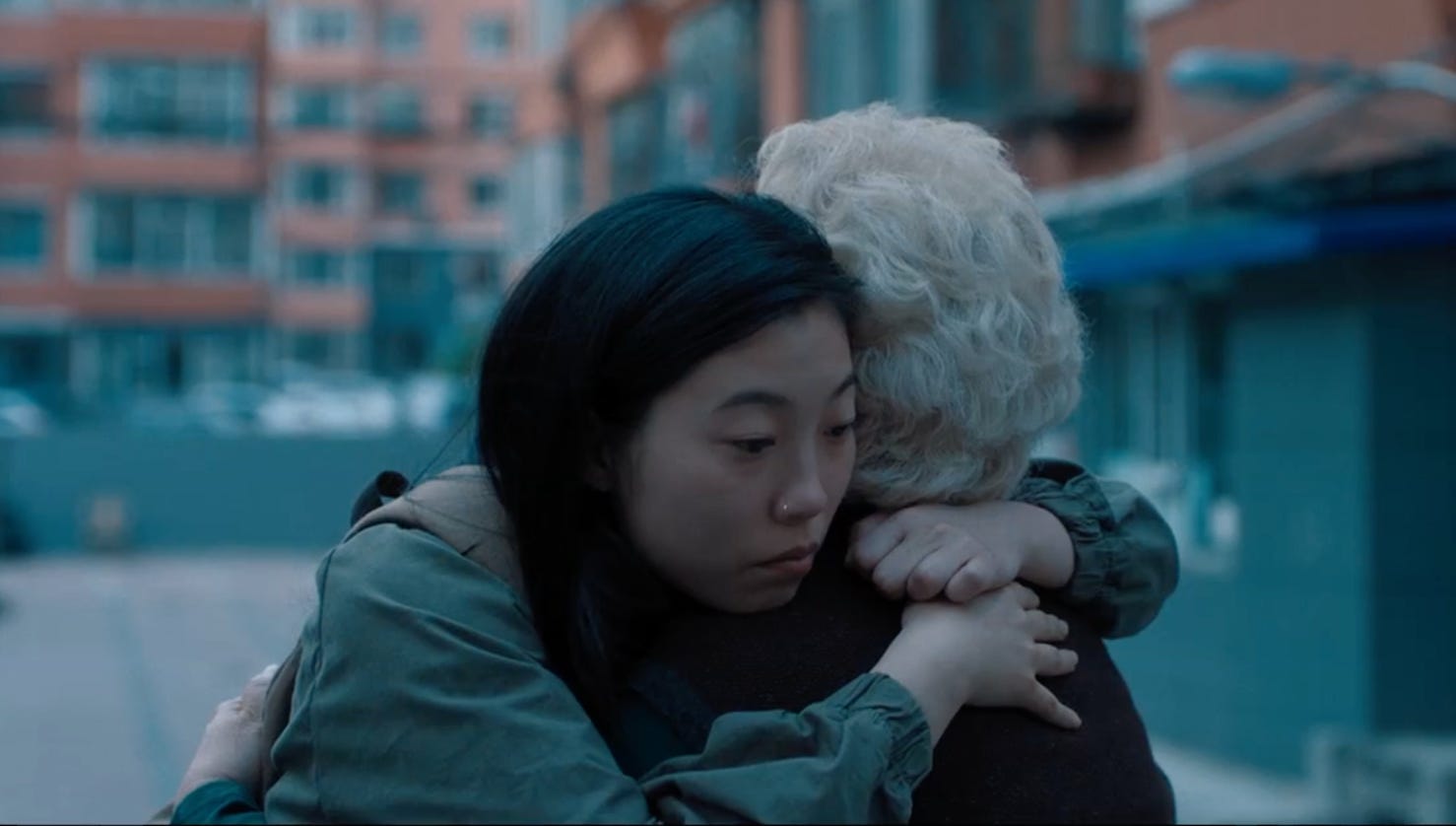
The weight of distance
There’s a particular guilt that belongs specifically to those who left.
Not the ordinary guilt of caregiving — the missed calls, the appointments you couldn’t attend, the moments you weren’t there for. This is something older and harder to name, and is what many immigrants feel. It’s the guilt of having pursued the life that took you away in the first place. Of having been encouraged to go, supported to go, and now standing at a distance watching something unfold that you can’t reach.
Billi carries this acutely. She left China young, and when her grandfather died, she never had a proper goodbye — he was simply gone. With Nai Nai, she’s watching the same clock run down, and she’s already grieving the time she won’t have.
You don’t need to have crossed an ocean for this to resonate. For many people I know — scattered across cities, countries, time zones — there’s a shared and largely unspoken reckoning that happens as parents age. The life we built somewhere else starts to feel like something we’ll eventually have to answer for. I was always aware this judgement day would arrive but it hasn’t made it easier to face the reckoning.
What I’ve come to understand is that distance doesn’t diminish the relationship — but it does change the texture of it. Care from afar is real care. It’s just care with different constraints, different rhythms, and a particular kind of grief baked into it: the grief of not being there even when you are, in every other sense, completely present.
The Farewell understands this. It doesn’t offer a resolution for it — because there isn’t one. But it holds it with honesty and, in its own quiet way, with grace.
Letting people in
The film ends without everything resolved. And yet there’s a quiet sense that something has shifted — not in the situation, but in Billi. She has been there and she has held it. That, in the end, is all that she could do.
Humans are messy. And perhaps that’s the most honest thing the film gives you — a conclusion with loose ends, but somehow enough of a sense of closure that allows you to move on.
I think about that in relation to Mum.
The fall is behind us now. We’ve talked about it — not the way I might have wanted to in the immediate heat of it, but enough. And I’ve come to understand that her instinct to shield me wasn’t about keeping me out. It was about not wanting to be the reason I worried, or dropped everything, or felt the weight of being far away more sharply than I already do.
She was protecting me the only way she knew how.
But what I want her to know — what I keep coming back to — is that being let in isn’t a burden. It’s the opposite. The moments that have mattered most in caring for her haven’t been the ones where everything was managed and under control. They’ve been the ones where I actually knew what was happening and could show up for it.
And we got through it together.
That’s all any of us want, really. Not to be shielded from the hard parts. Just to be trusted with them.
And if The Farewell asks one thing of its audience, I think it’s that — to have the conversation before the moment forces it. While there’s still time to choose how you want to hold it together.
The Farewell (2019) is available on Amazon Prime Video, Apple TV, and free on YouTube.
Join me at care4caregivers.substack.com for more stories, tools, and truths from the frontlines of caregiving.



Thanks for joining the Carevation list.

Carevation is a digital platform that helps caregivers manage appointments, medications, and the daily work of care — all in one place.

